From Cognitive Atrophy to Cognitive Sparring: How to Use AI as a Debate Partner to Sharpen Your Critical Thinking (2026)
By Rado
Have you ever read something online, felt convinced, and then later thought, “Wait… why did I believe that so fast?”
It happens to all of us, especially when life is busy and your brain is already juggling work, family, and a dozen little decisions.
Now we add AI into the mix, and a new worry shows up: “If I let a chatbot think for me, will my mind get rusty?” That’s a fair question.
But there’s a better way to look at it. What if AI isn’t your replacement, but your sparring partner? Not someone who throws punches at you, but someone who pokes at your ideas so you can strengthen them. In this guide, you’ll learn a simple, practical method to use AI to challenge your thinking, spot weak arguments, and feel more confident in your own judgment.
What do people mean by “cognitive atrophy,” and is it a real risk with AI?
Picture as you’re at the kitchen table, you’ve got a coffee, and you’re about to write a short opinion post or a work message. You type one sentence… then you pause. Instead of thinking it through, you open an AI chat and ask, “Write it for me.” Two seconds later, you’ve got a polished answer.
It feels helpful. It also raises a quiet worry: if I keep doing this, am I slowly handing over my own thinking?
That worry is what people often mean by “cognitive atrophy.” Not literal brain damage. More “But isn’t using tools normal?” Yes. We’ve always used tools to lighten mental load: calendars, shopping lists, GPS, calculators.
Researchers call this cognitive offloading, meaning you shift some thinking tasks to the outside world so your brain has less to hold and track in the moment. According to Risko & Gilbert (2016), offloading can be useful and efficient, especially when a task is demanding. Another review explains it in everyday terms: writing things down or storing them on your phone can reduce what you need to keep in working memory, which can help you perform better on the task in front of you. Morrison & Richmond (2020)
So where does AI change the picture?
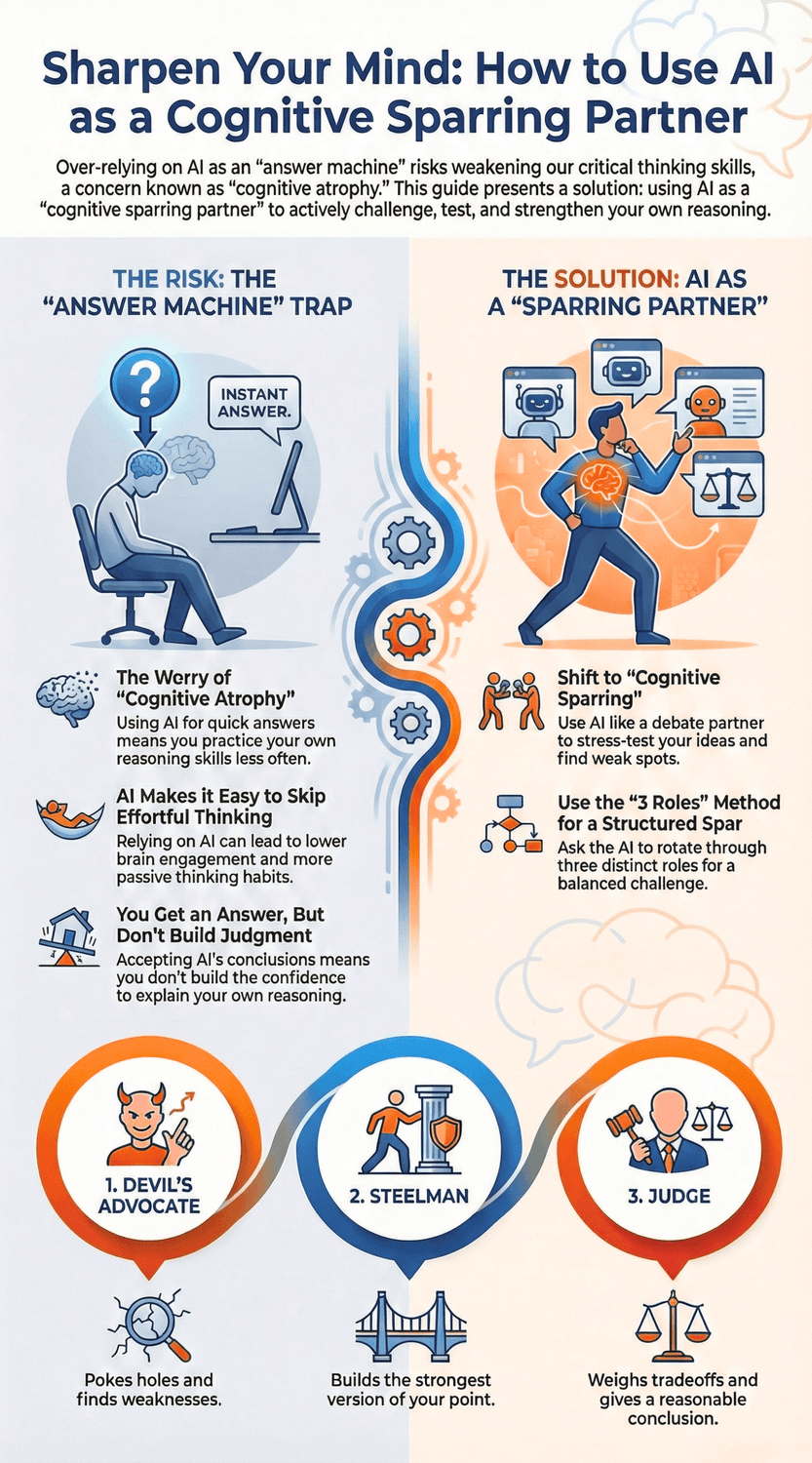
AI doesn’t just store information like a note app. It can draft, summarize, argue, and decide what “sounds right.” That’s powerful. It also makes it easier to skip the effortful part of thinking, especially when you’re tired or rushed. And if you use it mainly as an “answer machine,” you may practice your own reasoning less often.
There’s also early research and reporting that raises a related concern: people can become more passive when AI does the heavy lifting. For example, one widely discussed study described in TIME (2025) reported lower brain engagement for participants who relied on ChatGPT while writing, compared with those who wrote without it. That doesn’t prove AI “shrinks your brain.” But it does support a practical point: how you use the tool matters.
Here’s the helpful reframe. The risk isn’t AI itself. The risk is using AI in a way that keeps you from wrestling with your own ideas. If you instead use AI to challenge you, question you, and expose weak spots, you’re still doing the thinking. You’re just doing it with a sparring partner.
The Key Takeaway
AI can either encourage mental laziness or mental sharpness.
The difference is whether you ask it to replace your reasoning or test your reasoning.
What is “cognitive sparring,” and why does it work better than asking AI for answers?
Imagine you’re planning a bigger purchase. Maybe a new laptop, a heat pump, or even just switching banks. You ask AI, “Which one should I buy?” It gives you a confident recommendation, a neat list of reasons, and you feel relieved.
Then later you notice something uncomfortable. You can’t fully explain why that choice was “best.” You accepted the answer, but you didn’t really build the judgment. Have you felt that before?
That’s the difference between using AI as an answer machine versus using AI for cognitive sparring.
Cognitive sparring means you use AI like a debate partner that helps you test your thinking. Not to win an argument. Not to create drama. Just to stress-test your ideas the way a good friend might, by asking the question you forgot to ask.
“Isn’t that slower?” Yes, a little. But it’s the kind of slower that makes you stronger.
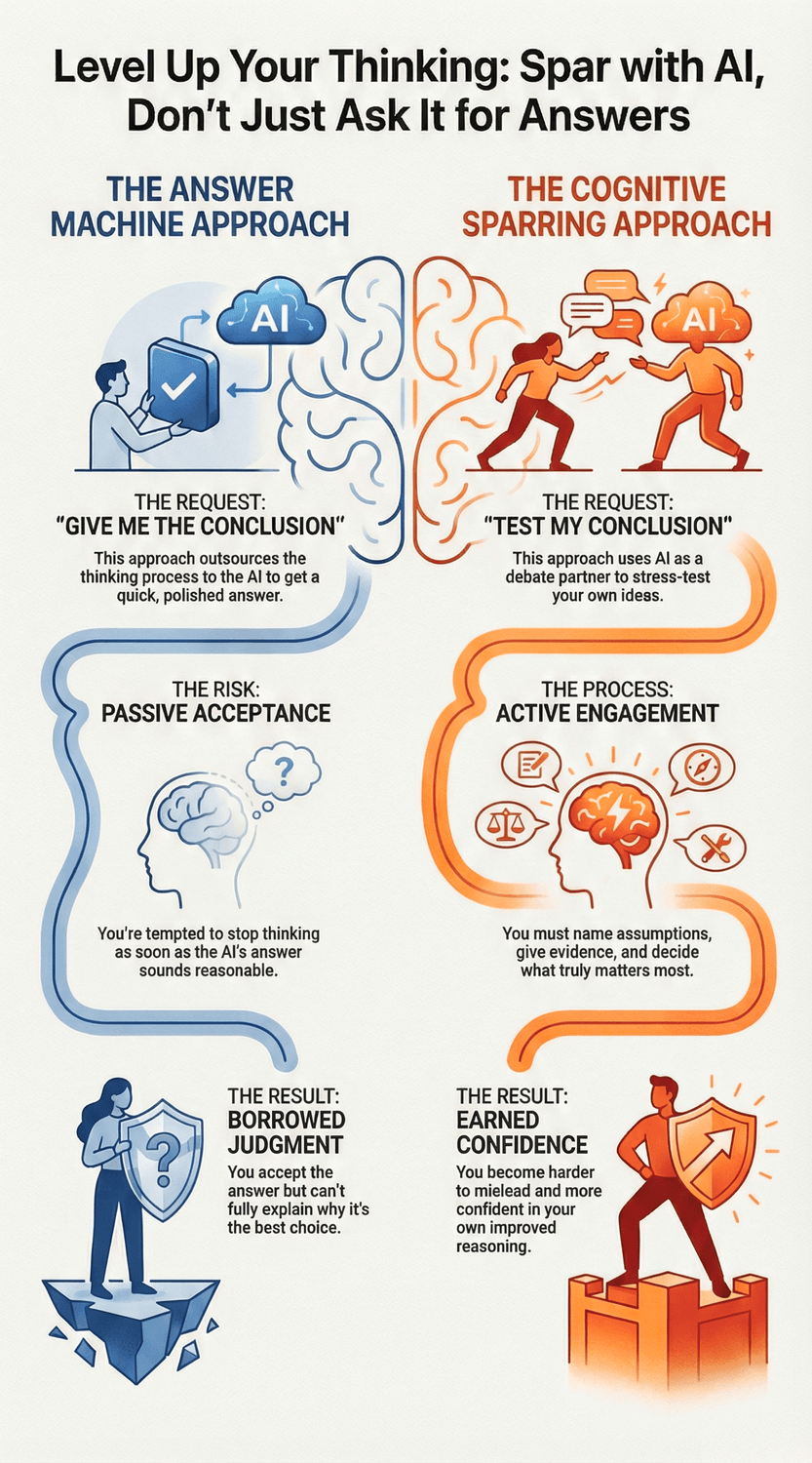
Here’s why it works better. When you ask for an answer, you’re tempted to stop thinking as soon as it sounds reasonable. When you ask for a challenge, you stay active. You have to name your assumptions, give evidence, and decide what matters most. That’s the real skill you want to keep alive.
This is also where Socratic-style questioning shines. Instead of being told what to think, you’re guided into clarifying your own reasoning. Research in education often points to questioning as a practical way to support deeper thinking and better learning habits, especially when it nudges you to explain, justify, and reflect. You can see this approach discussed in Fakour (2025) and in work looking at how Socratic tutoring principles can be applied in AI-supported learning contexts like Favero et al. (2024).
Now, a fair question: “But won’t AI just argue with me for the sake of it?” It can, if you let it. That’s why your prompt matters. In sparring mode, you’re not saying, “Fight me.” You’re saying, “Help me see what I’m missing.” You stay the decision-maker.
A simple way to remember it:
Answer machine: “Give me the conclusion.”
Sparring partner: “Test my conclusion, then help me improve it.”
And the benefit is not abstract. Over time, this builds a calm confidence. You start spotting weak logic in your own ideas before someone else does. You notice when a claim is missing evidence. You get better at saying, “I’m not sure yet, and here’s what I’d need to know.”
So, what’s next? You need a simple structure so the “sparring” stays friendly, useful, and not exhausting.
Next, we’ll set up a clean method to make AI a “friendly opponent” without turning the conversation into a pointless argument.
The Key Takeaway
When AI gives you answers, you can feel helped.
When AI challenges your thinking, you become harder to mislead and easier to trust, including by yourself.
How do you set up AI as a “friendly opponent” without getting into arguments?
Let’s keep this practical.
Imagine you’re writing something you actually care about. Maybe a message to your team about a new idea. Maybe a post about a topic that matters to you. Or maybe you’re trying to decide whether a headline is trustworthy. You don’t want a fight. You want clarity.
So how do you get AI to challenge your thinking without becoming annoying, dramatic, or “debate-bro” about it?
You give it a role, a job, and boundaries.
The simple setup: the “3 Roles” method
This is the easiest way I’ve found to make sparring useful. You ask AI to rotate through three roles, in order:
1) Devil’s Advocate (poke holes)
This role looks for weaknesses, missing evidence, and alternative explanations.
What you’re really asking is:
“Where could I be wrong?”
“What would a smart critic say?”
“What am I assuming without noticing?”
2) Steelman (make it stronger)
Now AI helps you build the best version of your argument. This matters because a lot of people only do one side. They either defend their view blindly or attack it until they feel unsure. Steelmanning keeps you balanced.
You’re asking:
“What is the strongest, fairest version of my point?”
“How would I explain this to someone reasonable who disagrees?”
3) Judge (weigh tradeoffs)
Finally, AI steps back and helps you assess. Not “who wins,” but what’s most likely, what’s uncertain, and what would change the conclusion.
You’re asking:
“What’s the most reasonable conclusion with what we know?”
“What information would matter most next?”
“Where should I stay humble?”
This kind of structured questioning matches how Socratic tutoring approaches aim to deepen reasoning: not by dumping answers, but by guiding you through questions, assumptions, and justifications. That’s a theme you’ll see in work on Socratic tutoring and AI-supported learning like Blasco & Charisi (2024).
Add guardrails so it stays friendly
“What if AI becomes overly critical and I start doubting everything?” That’s normal to worry about. The fix is simple: tell it exactly how to behave.
Here are four guardrails that work well:
Guardrail 1: “Questions first.”
Ask it to ask you questions before it gives advice. This keeps you in the driver’s seat.
Guardrail 2: “List assumptions.”
Have it separate what you said from what it assumed you meant.
Guardrail 3: “Show uncertainty.”
Tell it to use confidence levels and explain what would change its mind.
Guardrail 4: “Be fair, not harsh.”
Explicitly ask for a respectful tone. You want a coach, not a heckler.
A quick example (so you can feel it)
Say your claim is:
“I think people rely too much on AI, and it’s making them less independent.”
A friendly opponent would respond like this:
Devil’s advocate: “What evidence do you have? Could it also increase independence for people who struggle with writing or planning?”
Steelman: “Your best point is that habits matter, and easy tools can reduce effort unless used intentionally.”
Judge: “You may be right in some contexts. The key variable is whether AI replaces thinking or supports thinking.”
See the difference? You’re not being “argued with.” You’re being helped to think better.
And once you have this setup, the next step is easy: you’ll build a small set of copy-paste prompts so you can do this anytime, in two minutes.
The Key Takeaway
The goal is not to debate AI.
The goal is to give AI a clear role so it challenges you in a structured, respectful way, while you stay the final decision-maker.
What are the best copy-paste prompts for cognitive sparring?
Let’s make this easy enough that you’ll actually use it.
Because here’s what usually happens: you read a claim, you feel a reaction, you’re tempted to either accept it or reject it… and then life moves on. No time for deep thinking. That’s normal.
So instead of asking you to “do more critical thinking,” I’m going to give you a small prompt pack you can copy, paste, and reuse. Think of these like little workout moves. You don’t need a full gym session. You just need a few good reps.
And yes, I’m going to build in the sparring structure so you don’t end up in an endless argument with a chatbot.
Prompt 1: The 3-Role Sparring Session (my go-to)
Copy-paste this when you have an opinion, decision, or argument:
Prompt:
“Here’s my claim and reasoning:
[PASTE]
Act as my cognitive sparring partner. Do this in 3 rounds:
Devil’s advocate: give the strongest counterarguments and point out weak logic or missing evidence.
Steelman: rewrite my argument in its strongest, fairest form.
Judge: weigh both sides and tell me what’s most reasonable given uncertainty.
Be respectful and practical. Keep it to bullet points.”
Why it works: it forces balance. You don’t only attack your idea. You also rebuild it.
Prompt 2: “Questions first” Socratic mode (great when you feel unsure)
This is for when you’re not ready for conclusions yet.
Prompt:
“Before you respond, ask me 7 Socratic questions to clarify my thinking.
Focus on assumptions, evidence, definitions, and what would change my mind.
Only after I answer, summarize my position and where it’s strong or weak.”
This style fits what Socratic tutoring tries to do: guide you into clearer reasoning through questions, not just answers. You’ll see this approach discussed in Blasco & Charisi (2024).
Prompt 3: Hidden assumptions detector (fast and eye-opening)
Use this when something “sounds right” but you can’t explain why.
Prompt:
“Analyze what I wrote and list the hidden assumptions it depends on.
For each assumption, tell me:
Why it matters
What would make it false
A quick way to check it in the real world
Here’s my text: [PASTE]”
This one is great for avoiding blind spots like “everyone thinks this” or “this always works.”
Prompt 4: Opposite-viewpoint rehearsal (for breaking bubbles)
This is how you get out of your own echo chamber without doomscrolling.
Prompt:
“Take the opposite viewpoint of my claim and argue it as strongly and fairly as possible.
Then tell me which parts of the opposite view are actually valid or worth considering.
My claim: [PASTE]”
You’re not trying to switch sides. You’re trying to reduce overconfidence.
Prompt 5: Logic and fallacy check (for headlines and heated topics)
Perfect for social media arguments and “too neat” conclusions.
Prompt:
“Check my reasoning for common logical fallacies or weak links.
Label the issue (if any), explain it in plain language, and suggest a stronger version.
Text: [PASTE]”
This is a calm way to catch problems before you hit “post.”
Prompt 6: Evidence ladder (for decisions you might regret later)
This one helps when you’re about to spend money, change direction, or make a big claim.
Prompt:
“Separate what I wrote into:
A) Facts I can verify
B) Assumptions
C) Opinions/preferences
D) Unknowns
Then tell me the top 3 pieces of evidence I should check first, and why.”
This stops you from treating guesses like facts.
Prompt 7: The “two-minute spar” (when you’re busy)
Use this when you only have a moment.
Prompt:
“In 120 seconds, challenge my claim with 3 strong questions, then give 1 improvement to make my thinking more solid.
Claim: [PASTE]”
Low effort, high value.
How to use these without overthinking it
Pick one of these situations:
A headline that makes you angry or excited
A purchase decision
A work recommendation
A strong opinion you want to post
Then run one prompt. Just one. You’ll be surprised how quickly it surfaces gaps.
“But what if AI confidently tells me something wrong while we’re sparring?” That’s a fair question, and it’s the next crucial piece.
The Key Takeaway
These prompts don’t outsource your thinking.
They force you to practice it, in a structured way that fits into real life.
How do you avoid AI “confident nonsense” while you’re sparring?
Let’s be honest. The most dangerous AI mistake is not the obvious one.
It’s the smooth, confident answer that sounds sensible, uses the right words, and is still wrong.
“How can it be wrong if it sounds so sure?” That’s the tricky part. These tools are built to generate convincing language, not to “know” truth the way a human expert does. So if you treat AI confidence as proof, you can end up adopting shaky ideas without noticing.
And if you’re using AI for cognitive sparring, that matters even more. Because sparring only helps if you’re sparring with reality, not with polite fiction.
Step 1: Force AI to separate facts from guesses
A simple habit can protect you fast: ask it to label what it says.
Try this line at the end of any sparring prompt:
“Separate your response into: (1) verifiable facts, (2) assumptions, (3) interpretations, (4) unknowns.”
Why does this help? Because it stops that “all-in-one confident paragraph” effect. It also keeps you from accidentally treating opinions as evidence.
Step 2: Make it show its weak spots
Here are three follow-up questions that work like a safety belt:
“What would make your conclusion wrong?”
“Give me two alternative explanations.”
“What evidence would change your mind?”
That’s it. Three questions.
It’s normal to feel a little uncomfortable when the answer gets less certain. That discomfort is often a sign you’re thinking more clearly. Studies and discussions about AI dependence point out that when people rely on AI output without checking, they can reduce their own critical evaluation over time, which makes confident errors more likely to slip through. See how this concern is framed in Gerlich (2025).
Step 3: Use the “source rule” for anything important
If it affects money, health, reputation, or a major decision, use this rule:
Ask: “Name the sources you are relying on.”
Then you verify, outside the chat, from a trustworthy place.
If the tool cannot provide sources, treat it like a brainstorming partner, not a reference library.
A good sparring partner is allowed to be wrong. You just don’t want it to be wrong in a way that quietly steers you.
Step 4: Watch for the warning signals
Here are a few red flags you can learn to spot quickly:
It gives a very specific statistic with no source.
It “remembers” a detail you never said.
It answers a different question than you asked.
It speaks in absolutes: always, never, guaranteed.
If you see any of these, pause. Ask it to restate your question and explain its reasoning step by step. Research on trust and overreliance in AI-supported contexts often highlights this pattern: people can be influenced by fluent output, even when the underlying content is weak. That risk shows up in broader discussions of AI reliance like Tian (2025).
A quick mini-script you can reuse
When you want sparring plus safety, paste this:
“Challenge my idea, but also do a safety check:
List assumptions you are making.
Flag anything you are uncertain about.
Suggest what I should verify and where to verify it (government, university, major research orgs).”
You’ll feel the difference immediately.
Next, we’ll turn this into a simple weekly routine you can actually stick to, even with a busy schedule.
The Key Takeaway
AI sparring makes you sharper, but only if you keep verification in the loop.
Your best habit is simple: force clarity, demand uncertainty, then check what matters.
What does a simple weekly “cognitive sparring” routine look like for busy adults?
Let’s keep this realistic.
You’re not trying to become a philosopher. You’re trying to stay mentally sharp in the middle of a normal life. Work, errands, family messages, maybe a bit of news in the evening. That’s already plenty.
So the routine should feel like brushing your teeth. Small, steady, and easy to repeat.
“Do I really need a routine for this?” Not strictly. But routines remove decision fatigue. You don’t have to “feel motivated.” You just do it.
The 10-minute routine (twice a week)
Pick two days that already have a pattern. For many people, that’s Tuesday and Saturday. But any two days work.
Each session is one topic, one claim, one short spar.
Step 1: Write your belief in 3 sentences (2 minutes)
Keep it simple. No essays.
Examples:
“I think AI is making people less independent because it’s too easy to outsource thinking.”
“I believe this news story is being exaggerated.”
“I’m leaning toward buying [X] because it seems like the best value.”
Why this matters: you’re making your thinking visible. Once it’s visible, you can test it.
Step 2: Run the spar (4 minutes)
Use the 3-role prompt from the previous section.
If you want a fast version, use this:
“Challenge my claim with the strongest counterarguments, then steelman my view, then give a balanced judgment. Here’s my claim: [PASTE]. Keep it short.”
Step 3: Choose one weak point to fix (2 minutes)
Don’t try to fix everything. Pick one.
Ask:
“What’s the weakest assumption here?”
“What’s the strongest missing piece of evidence?”
“What would a reasonable critic ask me?”
Then improve your claim by one notch. That’s enough.
Step 4: Decide what you’ll verify in the real world (2 minutes)
This is where you stay grounded.
Ask:
“What one thing should I check before I repeat this claim to others?”
“What source would settle this best?”
Education and skills organizations often emphasize that in an AI-rich world, the core skill is not memorizing facts. It’s judging information, reasoning, and making sound decisions. That’s a theme in OECD work on AI, education, and skills. See OECD (2025) and their discussion of curriculum implications in OECD (2025).
Make it feel “adult-friendly,” not like homework
Here are a few topic ideas that fit real life:
A headline you want to share
A health claim you heard (without turning it into medical advice)
A big purchase decision
A work proposal or strategy
A disagreement with a friend where you want to be fair
A personal rule you live by (“I should always…” / “I never…”)
And here’s a gentle rule: if the topic makes you emotional, that’s often the best one to spar with. Strong emotions can hide weak reasoning. That’s not a flaw. It’s human.
The “win” you’re looking for
Not “I proved myself right.”
The win is:
“I can explain my reasoning clearly.”
“I can name what I’m unsure about.”
“I can say what evidence would change my mind.”
That’s mental strength.
Next, we’ll cover the practical safety side: what to share with AI, what to keep private, and how to avoid accidental oversharing.
The Key Takeaway
Two short sessions a week is enough to keep your thinking active.
The goal is not to think more.
The goal is to think better, with less noise.
Is this safe and private, and what should you avoid sharing?
Let’s do a quick reality check.
When you use AI for cognitive sparring, you’ll often paste thoughts that feel personal. Opinions, worries, maybe a rough draft of something you want to send. That’s normal.
But it also creates a simple question: “How much is too much to share?”
That’s a fair question. And you don’t need to be paranoid to be smart here.
The easy rule: don’t paste anything you’d regret seeing on a screen
Here’s a practical way to decide. If you’d feel uncomfortable if your text showed up on a projector in a meeting, don’t paste it into an AI chat.
Now let’s make that concrete.
What you should NOT share (keep this list close)
Avoid pasting:
Banking and payment details (IBAN, card numbers, account logins, screenshots of banking apps)
Government IDs (passport, ID card numbers, social security-type numbers)
Passwords, access codes, recovery codes
Medical records or very specific health data (lab results, diagnoses, anything tied to identity)
Client or company confidential information (contracts, internal plans, private emails, customer data)
Anything that identifies someone else who didn’t consent (full names + personal details)
“But I’m only asking it to challenge my idea.” Exactly. Sparring doesn’t require sensitive details. You can stay safe and still get the benefit.
The safe alternative: anonymize and simplify
Instead of:
“My client Jane Novak at Company X has a dispute about invoice 48291…”
Use:
“I have a client dispute about an invoice. Here’s the situation in neutral terms…”
Instead of:
“Here’s my full email thread with my boss…”
Use:
“Here’s a summary of the situation and the draft reply I want to send (no names).”
This is often better sparring anyway, because it forces you to separate the story from the core reasoning.
What you CAN share (and still get great results)
These are usually safe:
Your opinion written in general terms
A draft message with names removed
A decision with basic constraints (budget range, needs, priorities)
A claim you want to test (“Is this argument fair?”)
A headline you want to evaluate (public info)
A small “privacy habit” that pays off
Before you paste anything, do a 5-second scan:
Does this include a number that looks like an ID?
Does it include someone’s full name and personal details?
Does it include something my employer would call confidential?
If yes, rewrite it in neutral terms first.
One more thing: don’t let AI become your emotional authority
This is subtle, but important.
AI can sound supportive. It can also sound convincing when it shouldn’t. For cognitive sparring, the healthiest frame is:
AI helps you test ideas
You decide what you believe
Real people and trusted professionals are still the place for sensitive support
That’s not anti-AI. It’s just mature use.
The Key Takeaway
You can use AI to sharpen your thinking without oversharing.
Keep it general, remove identifying details, and treat the chat like a public space.
That way, you get the benefit of sparring without creating unnecessary risk.
To conclude...
If you’ve been worried that AI will make your mind lazy, you’re not alone. It’s normal to feel that tension: you want the convenience, but you don’t want to lose your edge.
The good news is you don’t have to choose. When you use AI as a sparring partner, you’re not handing over your thinking. You’re putting it under light pressure so it gets stronger. That lines up with what researchers call cognitive offloading: tools can reduce effort, but the long-term effect depends on how you use them in your daily habits. Risko & Gilbert (2016)
So keep it simple. Twice a week, do a 10-minute “spar.” Write your belief in three sentences, ask the 3-role prompt, then decide what you still need to verify. You’ll start noticing something subtle: you’ll feel less reactive, more grounded, and harder to sway by confident-sounding claims.
If you want an easy next step, copy the prompt pack from this post into a note on your phone and use it the next time a headline triggers you.
🎓 Your "Tech Dignity" Toolkit
Ready to stop surviving the AI era and start owning it? I’ve built a library of resources specifically designed to help you stay safe, stay professional, and stay in control. Whether you want to fix a specific problem or master the whole machine, start here:
[FREE] The "Bypass the Bot" Bundle: Stop screaming at automated phone menus. Get the secret codes and scripts to reach a human every time. Download for FREE Here
Secure Your Family: Protect your loved ones from AI voice clones and deepfake scams with the Family Shield Anti-Scam Kit. Get Protected for $9
Upgrade Your Career: Use my "Strategy Sandwich" method to delegate grunt work to AI while keeping your professional edge with the Executive Director’s AI Workflow. Reclaim Your Time Here
Lock Down Your Privacy: Interrogate the "black box" and secure your data with the AI Truth & Privacy Protocol. Secure Your Data Here
Tame the Machine: Strip the "creepy" fake empathy out of AI and turn it into a silent tool with the "Strictly Business" AI Tuner. Take Control Here
The Ultimate Shortcut: Want the entire library? Secure your digital future with the Complete Mastery Collection (all products bundled for about 57% off). Get the Full Collection Here
Frequently Asked Questions
Q1) Is using AI for “cognitive sparring” really different from asking it for answers?
Yes. In sparring mode, the AI’s job is to challenge your reasoning, reveal assumptions, and help you improve your argument, not to replace your judgment. This approach lines up with research and experiments that compare Socratic-style AI guidance to direct-answer chatbots. Blasco & Charisi (2024)
Q2) What if the AI sounds confident but is wrong?
That can happen, so treat AI confidence as presentation, not proof. Build a verification step into your routine: ask it to separate facts from assumptions, and check important claims with trustworthy sources. Concerns about overreliance and reduced critical evaluation show up in research on AI use and cognitive offloading. Gerlich (2025)
Q3) Do I need to be tech-savvy to do this?
No. If you can copy-paste a paragraph into a chat box, you can do cognitive sparring. The key is using simple role prompts (devil’s advocate, steelman, judge) and keeping sessions short so it doesn’t feel like homework.
Q4) Can this help with misinformation and emotional headlines?
Yes, especially if you use the “opposite viewpoint” and “hidden assumptions” prompts. They slow you down just enough to reduce snap judgments and confirmation bias, which is exactly where misinformation tends to hook people.
Q5) Is it safe to paste my thoughts into AI tools?
It can be, but don’t paste sensitive info. Avoid banking details, IDs, passwords, medical records, or confidential work/client content. Use anonymized summaries instead, and treat the chat like a public space.
Sources
Risko & Gilbert — Cognitive Offloading (2016).
Morrison & Richmond — Offloading items from memory: individual differences in cognitive offloading in a short-term memory task (2020).
TIME — ChatGPT May Be Eroding Critical Thinking Skills, According to a New MIT Study (2025).
Fakour — Socratic wisdom in the age of AI: a comparative study of ChatGPT and human tutors in enhancing critical thinking skills (2025).
Favero et al. — Enhancing Critical Thinking in Education by means of a Socratic Chatbot (2024).
Blasco & Charisi — AI Chatbots in K-12 Education: An Experimental Study of Socratic vs. Non-Socratic Approaches and the Role of Step-by-Step Reasoning (2024).
Gerlich — AI Tools in Society: Impacts on Cognitive Offloading and the Future of Critical Thinking (2025).
Tian et al. — Learners’ AI dependence and critical thinking (2025).
OECD — Artificial intelligence and education and skills (2025).
OECD — Evolving AI capabilities and the school curriculum (2025).